
Understanding Lower Face and Neck Aging
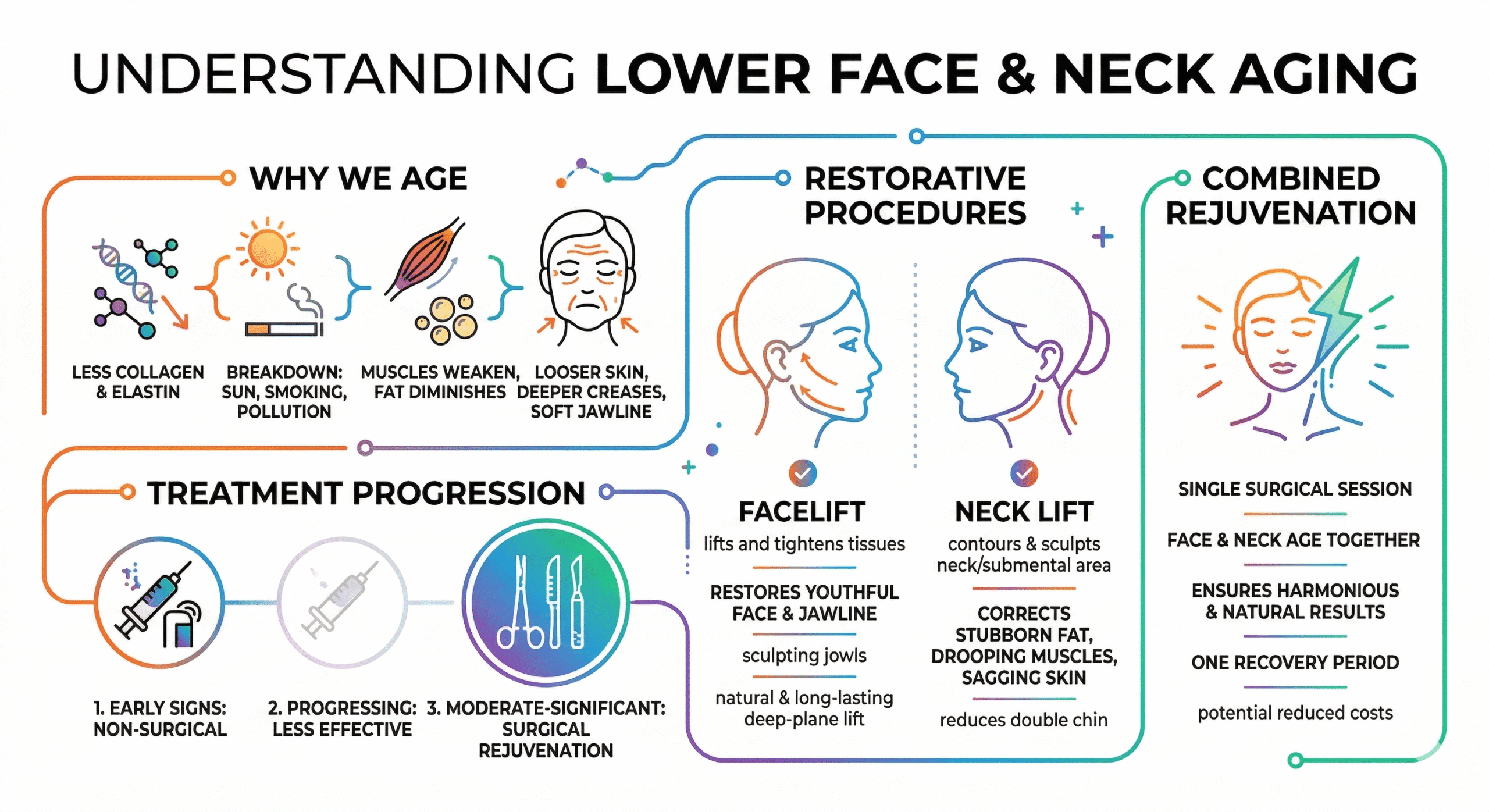
Many patients begin to notice early changes in the lower face and neck over time, including looser skin, deeper creases, and a softer jawline. These changes often become more noticeable in the 30s and 40s, though timing varies from person to person.
Lower face and neck aging is the result of several factors. The body naturally produces less collagen and elastin protein with age, causing the skin to lose its elasticity and firmness. These proteins are also gradually broken down by sun exposure, smoking, and pollution.
Additionally, the muscles of the face and neck weaken over time, and fatty tissue beneath the skin diminishes. These changes lead to reduced support for the skin, creating an aged appearance.
Early signs of aging can often be managed with dermal fillers and non-surgical treatments. But as these concerns progress, non-invasive options become less effective. When moderate to significant signs of aging are no longer responding to those treatments, it may be time to consider a facelift or neck lift.
A full facelift is designed to address sagging in the midface, lower face, and jawline. A neck lift is designed to tighten the neck and the area below the chin, commonly called the submental region.
How a Facelift Improves the Jawline and Lower Face
A facelift, also called a rhytidectomy, involves lifting the sagging tissues of the face, restoring a more youthful appearance.
A facelift, or rhytidectomy, address a wide variety of aging concerns. This procedure targets shallow, moderate, and deep facial wrinkles in the midface and lower face, including the nasolabial folds, parentheses lines, and marionette lines.
A facelift also brings back definition to drooping facial contours in the mid and lower face. This includes sculpting the jawline and reducing the appearance of sagging jowls.
Different types of facelifts lift from various depths.The deeper the lift, the more natural-looking and longer-lasting the results.
- Traditional skin-only facelifts: These lift from the skin.
- SMAS facelifts: These lift from the SMAS (superficial musculoaponeurotic system) layer.
- Deep-plane facelifts: These lift from the deep plane (beneath the SMAS).
The SMAS facelift and the deep-plane facelift also involve releasing ligaments in the face. These ligaments connect fat, skin, and other tissues to certain facial structures. When they are released, this allows for more extensive repositioning.
Ideal Candidates for a Facelift
Ideal candidates for a full facelift in Indianapolis are patients with moderate or significant facial age signs, including nasolabial folds and drooping facial skin. The best candidates are people whose facial age signs make them look older than they actually are and older than they feel.
Good full facelift candidates are often in their 60s or older, though many are in their 40s or 50s. Rather than focusing on age as the primary deciding factor, it’s best to consider the severity of the age signs.
The best facelift candidates:
- Are non-smokers or are willing to quit
- Are in good overall health
- Are not currently pregnant or breastfeeding
- Have realistic expectations for their results
How a Neck Lift Improves the Neck and Submental Area
A neck lift is a facial plastic surgery procedure that uses several techniques to contour and sculpt the neck and submental region.
Neck lifts correct concerns such as stubborn neck fat, drooping neck muscles, and sagging neck skin. This procedure is a popular option for reducing the appearance of a double chin, prominent platysmal neck bands, and a turkey-wattle neck.
During a neck lift, several techniques may be performed depending on the patient’s needs. Liposuction may be used to remove stubborn fat. This involves inserting a cannula, loosening the fat cells from the surrounding tissues, and suctioning them out of the area through the cannula.
Platysmaplasty may also be performed to tighten the loose muscles of the neck. This technique involves placing internal sutures in the muscles.
Additionally, cervicoplasty may be used. This involves the removal of excess drooping neck skin with the help of a scalpel. The remaining skin is then tightened, creating a smoother, more youthful neck contour.
Ideal Candidates for a Neck Lift
Ideal candidates for neck lift surgery in Indianapolis are patients with aesthetic issues in the neck and submental area, including excess neck fat and skin, a double chin, a turkey-wattle neck, and prominent neck bands. People who feel that their neck makes them look out of shape or older are excellent candidates for a neck lift.
Neck lift candidates are typically in their 40s through 60s. Depending on their neck anatomy, younger and older patients can also be suitable candidates.
As with facelift candidates, the best neck lift candidates:
- Do not smoke (or are willing to quit before the procedure)
- Are in good general health with no pre-existing conditions that could cause complications
- Are not breastfeeding or pregnant
- Have realistic expectations for neck lift results
Can a Facelift and a Neck Lift Be Combined?
Many patients benefit from combining a facelift and neck lift in a single surgical session, and there are several reasons this approach works so well.
Because the structures of the face and neck are closely connected, they age together. The descending of facial fat pads can affect the neck, as can the sagging of facial skin and muscles.
Due to the connected nature of the face and neck, combining a facelift and a neck lift is the best way to ensure that your face and neck experience the same degree of rejuvenation. Performing both procedures together also gives the facial plastic surgeon more control over the final result. This produces the most natural appearance possible.
Additionally, combining both procedures into one session means just one recovery period, so patients can return to their daily routine sooner. It can also reduce overall costs compared to scheduling two separate surgeries
Choosing the Right Procedure for Your Goals
Both the facelift and the neck lift can address numerous age-related issues. A facelift is generally best for midface, lower-face, and jawline issues like jowls, wrinkles, and lax skin. A neck lift is generally best for neck and submental issues like drooping neck skin, a double chin, and neck fat.
In the end, choosing between a facelift and a neck lift comes down to your specific goals. Discussing your options with a highly experienced board-certified facial plastic surgeon is the ideal way to select the right procedure.
During a consultation, your facial plastic surgeon will tell you more about each procedure. They will evaluate your face and neck, ask questions about your medical history to ensure that you’re a safe candidate, and ask you about your needs and goals in great detail. After this, they will give you a thoughtful and considered recommendation.
Arrange a personalized facial plastic surgery consultation with Dr. Catherine P. Winslow at our Indianapolis facility to learn more. Contact (317) 814-1104 or fill out our contact form to set up your appointment.
